How to Tell If Gold Is Real in Canada: Tests & Stamps
Learning how to tell if gold is real in Canada starts with a rule that protects you from most mistakes: no colour check, magnet trick or stamp, by itself, proves that an item is solid gold. A reliable answer comes from combining the marks, weight and dimensions with a non-destructive professional test. That evidence ladder matters whether you are buying jewellery, inheriting a chain, checking a coin or deciding whether a cash-for-gold offer is based on the purity the buyer claims.
Canada has another feature that surprises many buyers. A precious-metal quality mark is not mandatory here, but if one is used, the Competition Bureau’s marking rules require it to be truthful and in the prescribed form. A stamp is therefore useful evidence, not a certificate. Start with what the item claims to be, then test whether its physical behaviour supports that claim.
How do you authenticate gold?
Authentication means establishing three separate facts: the metal, the purity and, for a branded coin or bar, whether this specific piece is genuine. A home check may help with the first two, but only a suitable instrument or assay settles all three. The strongest common method at a Canadian dealer or refiner is X-ray fluorescence, usually called XRF. It reads the metal at and near the surface without cutting the piece. That is valuable for jewellery and coins, although a very thick plating, a filled core or an unusual construction can require a second method.
Ask the tester to explain what the instrument can and cannot prove. A professional may also compare exact weight and dimensions, inspect edges and construction, use density or ultrasound on suitable bars, or recommend a destructive fire assay when the value justifies it. Never authorize cutting, filing or melting merely to satisfy curiosity. For a high-value item, get two independent opinions and ask for the result in writing, including whether the reading was surface-only.
Canadian Mint products have product-specific defences. The Royal Canadian Mint says its Bullion DNA technology supports authentication of Gold Maple Leaf coins dated 2014 and later, while current coins also use radial lines and a micro-engraved maple leaf whose centre shows the year under magnification. A registered Bullion DNA dealer can check a coin against that system. A correct-looking maple leaf alone is not enough; the dealer verification is the point.
How do you know if something is real gold?
Work from least damaging to most reliable. First inspect the item in bright light. Look for a purity mark, a maker or trademark, worn edges where a different-coloured metal shows through, green or black discoloration, and seams or a magnetic clasp. Wear does not prove an item is fake—gold alloys can tarnish slightly and clasps may contain steel springs—but obvious base metal at rubbed corners is a warning that the piece may be plated.
A strong magnet is a screen, not a verdict. Solid gold is not attracted to an ordinary magnet. If the whole piece jumps, it is unlikely to be solid gold. If nothing happens, you have learned very little: copper, brass, lead, tungsten and many counterfeit alloys are also weakly magnetic or non-magnetic. Test the body of the item rather than a spring clasp, and never use the result alone to buy or reject it.
Weight and measurements are stronger for coins and plain bars because genuine products have published specifications. Use a calibrated scale and calipers, then compare weight, diameter and thickness together. A piece can have the right weight and wrong dimensions, or the right diameter and be too light. Jewellery is harder because hollow links, gemstones, enamel, solder and steel mechanisms change the total. Online density calculators can help with a plain solid object, but a water-displacement result for a stone-set or hollow jewel is not a purity reading.
Skip the folklore when money is involved. A ceramic streak can scratch a soft item and still cannot identify an alloy precisely. Bite tests damage teeth and metal. Vinegar, bleach and household acid are unreliable and may create a hazard or spoil the finish. Acid testing belongs with a trained tester who knows the stone, the safety controls and the limits of the result.
What does 825 mean on jewelry?
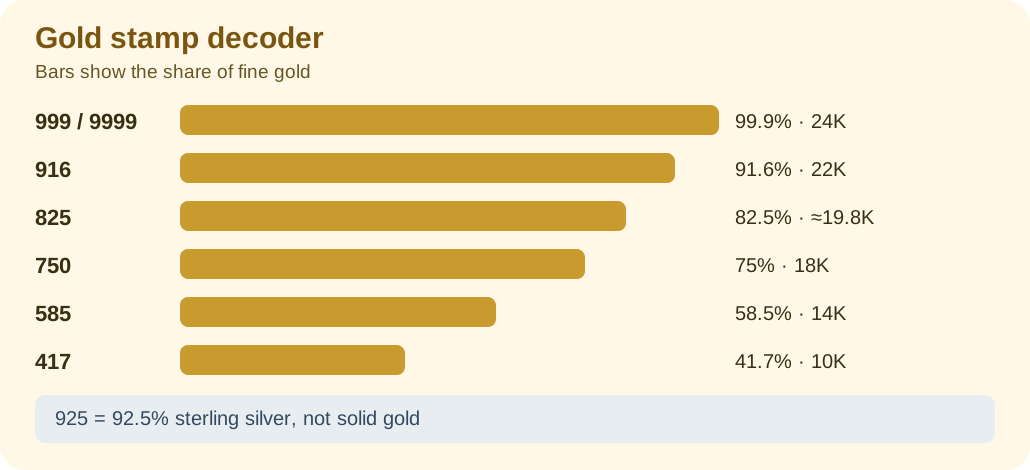
The stamp table below translates the numbers you are most likely to see. A three-digit mark normally states parts per thousand. Divide it by 1,000 to get the proportion, or by 41.667 for an approximate karat value.
| Mark | Fine gold content | What it usually means |
|---|---|---|
| 999 or 9999 | 99.9% or 99.99% | Fine bullion, normally called 24K |
| 916 | 91.6% | 22K gold |
| 825 | 82.5% | About 19.8K by arithmetic; not one of Canada’s familiar standard marks, so have the item tested |
| 750 | 75.0% | 18K gold |
| 585 or 583 | 58.5% or 58.3% | 14K gold |
| 417 | 41.7% | 10K gold |
| 375 | 37.5% | 9K gold |
| 925 | 92.5% silver | Sterling silver, not a gold purity mark |
825 means 825 parts out of 1,000 are gold if the mark is genuine—82.5% pure. It sits between the familiar 18K and 22K standards. Because counterfeiters can copy a stamp in seconds, its unusual status is exactly why a professional test matters. It does not mean 825 karats, and it should not be valued as 22K without evidence.
What does “925 Italy” refer to on a gold chain necklace?
“925 Italy” normally means the chain is sterling silver made in Italy and finished to look gold. The 925 identifies 92.5% silver. It may be gold-plated or vermeil—gold over sterling silver—but it is not solid gold. This is one of the most profitable misunderstandings in the second-hand market because a yellow surface and the word Italy can distract from the number. Read the number first.
Other letters deserve the same caution. GF means gold filled, GP gold plated, GEP gold electroplate and RGP rolled gold plate. These products contain a surface layer of gold over another material and should not be priced as solid karat gold. Canada’s official marking guidance gives different requirements for filled, rolled and plated articles, another reason to ask exactly what construction the seller means by “gold.”
Our gold purity guide explains karats and millesimal fineness in more depth, and the karat converter translates a stamp into percentages before you negotiate.
How to tell if gold is real in Canada: hallmarks and the law
Canada does not operate the same compulsory hallmarking system many people associate with the United Kingdom. The Competition Bureau explains that applying a quality mark is optional. If a dealer does apply one to a gold article, it must truly indicate quality; gold can be described by karat or decimal marks such as .583 for 14K and .750 for 18K. In general, a Canadian quality mark must be accompanied by a registered Canadian trademark applied the same way, subject to recognized foreign-hallmark exceptions. Therefore, “no stamp” does not automatically mean fake, and “has a stamp” does not end the inquiry.
The Bureau’s own jewellery inspections used XRF and sent problematic articles to the Royal Canadian Mint for further testing. That is a useful model for consumers: screening first, specialist confirmation when the result or value demands it. If a seller misrepresented a plated or lower-purity item as solid gold, keep the receipt and advertisement and contact the Competition Bureau or your provincial consumer-protection office.
Where to get gold checked in Canada—and the scams to avoid
An established bullion dealer, independent jeweller, refiner or assay service can test most pieces. Call first and ask four questions: Which method will you use? Is it non-destructive? Will you test in front of me? What will you charge if I decide not to sell? A reputable shop should be comfortable with all four. Do not leave a valuable item without a detailed receipt, and never let a buyer take it out of sight for an unexplained “back-room test.”
The RCMP has warned about people in Canadian parking lots using urgency and sympathy stories to sell jewellery represented as gold that later proved fake or nearly worthless. The same warning applies in reverse to unsolicited buyers who appear at a hotel, home or parking lot. Pressure is not a testing method. Walk away, choose the shop yourself and take the time the value deserves.
Once you know the purity, our guide to selling gold in Canada shows how to turn weight and fineness into the melt value behind a quote.
Frequently Asked Questions
How do you authenticate gold?
Use evidence in layers: documents and marks, exact weight and dimensions for coins or bars, then a professional non-destructive test such as XRF. Mint coins may also be verified through the maker’s system. A single home trick is not authentication.
How do you know if something is real gold?
You do not know from colour or a magnet alone. Check the stamp, inspect worn areas, compare specifications when they exist and have a dealer or assayer test the metal before paying or accepting a low offer based on a disputed purity.
What does 825 mean on jewelry?
If genuine, 825 means 82.5% gold, or about 19.8K. Because it is not a common standard Canadian mark and stamps can be copied, value it only after an independent purity test.
What does “925 Italy” refer to on a gold chain necklace?
It normally identifies a sterling-silver chain made in Italy, often with a gold-coloured plated or vermeil finish. It is not solid gold.
Does a magnet test prove gold is real?
No. Strong attraction is a warning, but no attraction proves very little because several non-gold metals and counterfeit alloys also do not stick to a magnet. Use the magnet only as a first screen.