Is Now a Good Time to Buy Gold in Canada? How to Decide
"Is now a good time to buy gold in Canada?" is the most-asked question in Canadian gold forums — it titles threads in bull markets, in crashes, and in flat years alike. Nobody can answer it with a date, and this guide won't pretend to: there are no forecasts here. What you can do is replace the timing question with a set of questions that actually have answers — about your purpose, your time horizon, and the two Canada-specific mechanics, the exchange rate and the premium, that decide what you really pay.
Gold, silver and miners... time to buy?
That long-running Canadian forum thread bundles three different decisions into one title. Miners are shares in companies — they carry operating costs, management and stock-market risk on top of the gold price, and they can fall while gold rises. Silver is gold's volatile smaller sibling, with industrial demand swinging it harder in both directions. Physical gold and bullion funds are the direct metal exposure. This guide is about timing the metal; if your question is really about mining shares, you are asking a stock-market question, and the framework below doesn't apply to it.
The Canadian twist: you buy gold in two currencies at once
The world price is set in US dollars. The Canadian price is that price multiplied by the USD/CAD exchange rate — the full formula is in our guide to what the price of gold is today, and the live result is on the gold price Canada hub. This creates a situation American advice never mentions: gold can be flat in US dollars and climbing in Canada because the loonie weakened, or hitting records in the US while a strong loonie keeps the Canadian price contained.
So "is gold expensive right now?" has two halves. Before you buy, look at both: where the US-dollar price sits, and where the loonie sits. A weak Canadian dollar has quietly padded Canadian gold returns for years — and it can just as quietly take some back if the loonie strengthens while you hold.
What you can control: the premium and the round trip
You cannot control the spot price. You can control the premium you pay over it — and premiums are a timing variable you can actually see. In calm markets, standard 1 oz products carry modest premiums and dealers compete. In panic weeks — a crash, a crisis headline — premiums widen across the whole market at the same moment everyone wants to buy. The buyers who pay the worst prices in gold are usually not wrong about direction; they bought a fine asset at a panic premium, then faced the second cost: dealers buy back below spot, so a standard bar needs the price to climb several percent before a quick resale breaks even.
That arithmetic is also why the scrap-gold version of the timing question — a forum poster thinking of "ploughing spare funds into scrap gold" and asking how long before they'd expect to sell — is the hardest version of all. Scrap carries dealer discounts on the way in and on the way out, so its round-trip spread is the widest of any gold purchase. Scrap rewards people who buy it well below melt value, not people timing the headline price.
Buying in stages: the answer most long-term buyers land on
If your purpose is long-term — insurance against currency and financial stress, a store of value outside the banking system — the stage-buying approach used by most patient accumulators removes the timing bet: divide the total you intend to hold into several purchases spread over months, at regular intervals or at price levels you choose in advance. You will never buy it all at the exact bottom, and you will never buy it all at the exact top either. Your average premium is also likely to be a calm-market premium, because most of your purchases will land in ordinary weeks.
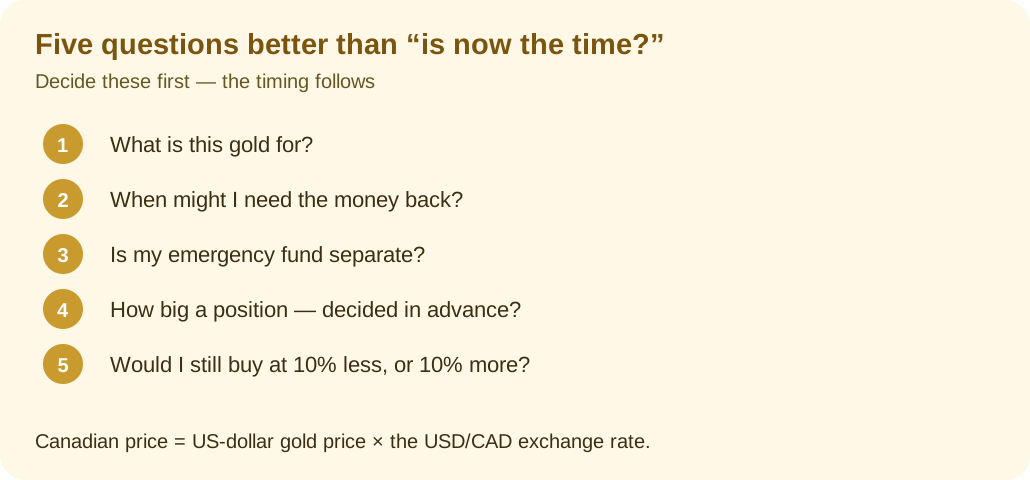
Five questions that are better than "is now the time?"
- What is this gold for? Long-term insurance and savings behave differently from a trade. If you can't state the job, you can't judge the timing.
- When might I need this money back? Gold's buy-sell spread punishes short horizons. Money needed within a year or two is usually in the wrong place.
- Is my emergency fund separate? Gold you might be forced to sell in a bad month is not insurance; it's a risk.
- How big a position? Decide the share of your savings gold should be before prices seduce or frighten you — then the daily price stops being the decision.
- Would I still buy at 10% less — or 10% more? If a drop would scare you out, stage the purchase. If a rise would make you chase, set your levels now.
The signals everyone watches — and their limits
Real interest rates, central-bank buying, the US dollar's trend and crisis demand all genuinely move gold, and financial media will happily rank them for you daily. What the record shows is that each signal has also failed for years at a stretch, usually right after it became the consensus reason to buy or sell. Treat them as context for understanding moves after they happen — not as a clock for your purchase. Our gold investment calculator is a better use of the same hour: model what a holding does across flat, rising and falling scenarios, and see whether the decision still makes sense in all three.
This guide is educational and deliberately evergreen: it describes a decision framework, not a recommendation, and it makes no forecast about where the gold price goes next. Gold can fall as well as rise, and past performance does not predict future results.
Frequently Asked Questions
Is it a good time to invest in physical gold bullion?
There is no universally right date — the honest answer depends on your purpose and horizon, not on the headline price. For long-term holders, the questions in this guide (purpose, horizon, position size, premium paid) matter more than whether this particular week is the bottom. If you would need to sell within a year or two, the buy-sell spread makes almost any "now" a poor time.
Is NOW the time to buy gold?
The all-caps version of the question usually appears at moments of maximum emotion — after a big rise or a frightening headline — which is exactly when premiums are widest and decisions are worst. Check the premium on what you're buying against calm-market levels, consider buying in stages, and let your pre-set plan, not the thread title, make the call.
Should I wait for gold to drop before buying in Canada?
Waiting is a bet that two prices — gold in US dollars and the Canadian dollar itself — will both move your way. Sometimes it works; often the drop never reaches the level people wait for, or the loonie weakens and erases it in Canadian terms. Staged buying is the middle path most long-term buyers use instead of an all-or-nothing wait.
Does a weak Canadian dollar change the timing answer?
It changes the price you pay, yes. A weak loonie makes gold more expensive in Canada even when the US price is calm, and a strengthening loonie can discount it. Look at both halves of the Canadian price before deciding — a "high" Canadian price can be a currency story rather than a gold story.
Is buying gold a wise investment?
Gold is best understood as a store of value and insurance asset rather than a growth investment: it produces no income, and its price can fall for years. Whether it is wise depends on the job you give it in your overall finances — sized sensibly, bought at a fair premium and held for the long term, it has done that job for Canadian savers for decades. Sized as a speculation, it behaves like one.