Gold vs Silver vs Platinum in Canada: Which to Buy?
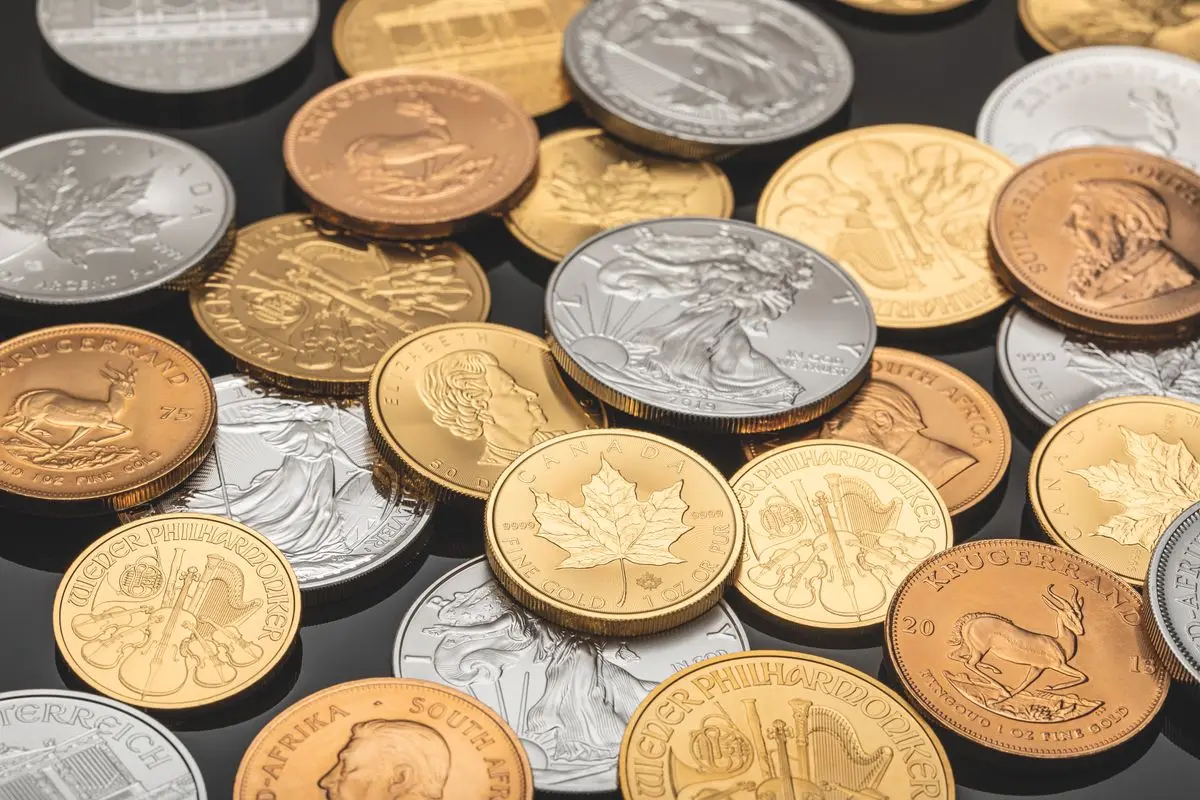
Gold vs silver vs platinum in Canada is not a contest with one permanent winner. It is a choice between three different kinds of exposure: gold’s deep monetary market, silver’s smaller and more industrial market, and platinum’s concentrated, heavily industrial one. The right answer depends on why you are buying, how much physical bulk you can store, what premium you pay, and—just as important—who will buy the exact product back from you in Canada.
This guide makes no forecast and does not treat any metal as guaranteed. It compares the roles, costs, Canadian tax treatment and exit routes honestly, so a Canadian buyer can match the metal to the job instead of copying a slogan from a forum.
Should I buy silver or gold or platinum?
Start with the job. If the goal is to hold the most value in the least space and sell into the deepest market, gold usually fits best. If the goal is to begin with a lower cash amount per ounce and you accept larger price swings and much more storage bulk, silver may fit. If you deliberately want a scarcer precious metal whose demand is tied more closely to industry and vehicle catalysts, platinum is the specialist choice—but only after you have confirmed a competitive Canadian buyback.
| Question | Gold | Silver | Platinum |
|---|---|---|---|
| Main role | Monetary metal, jewellery and reserves | Monetary and industrial metal | Primarily industrial metal with investment demand |
| Value in a small space | Very high | Low compared with gold | Very high |
| Typical market feel | Deepest and most liquid of the three | Smaller market, often sharper percentage moves | Smaller, concentrated market; product choice matters |
| Canadian product range | Very broad | Very broad | Narrower |
| Storage issue | Compact | Bulky at meaningful values | Compact |
| Main beginner trap | Paying a high premium for a tiny or collectible product | Confusing a low ounce price with a low percentage cost | Buying before checking the local exit price |
The table is a framework, not a ranking for every person. A buyer who wants jewellery will use the metals differently from a buyer who wants sealed bullion. A buyer who may move overseas needs recognizable products. A buyer with no secure storage may discover that the “cheapest” metal per ounce is the most expensive to protect.
Gold: compact value and the deepest exit
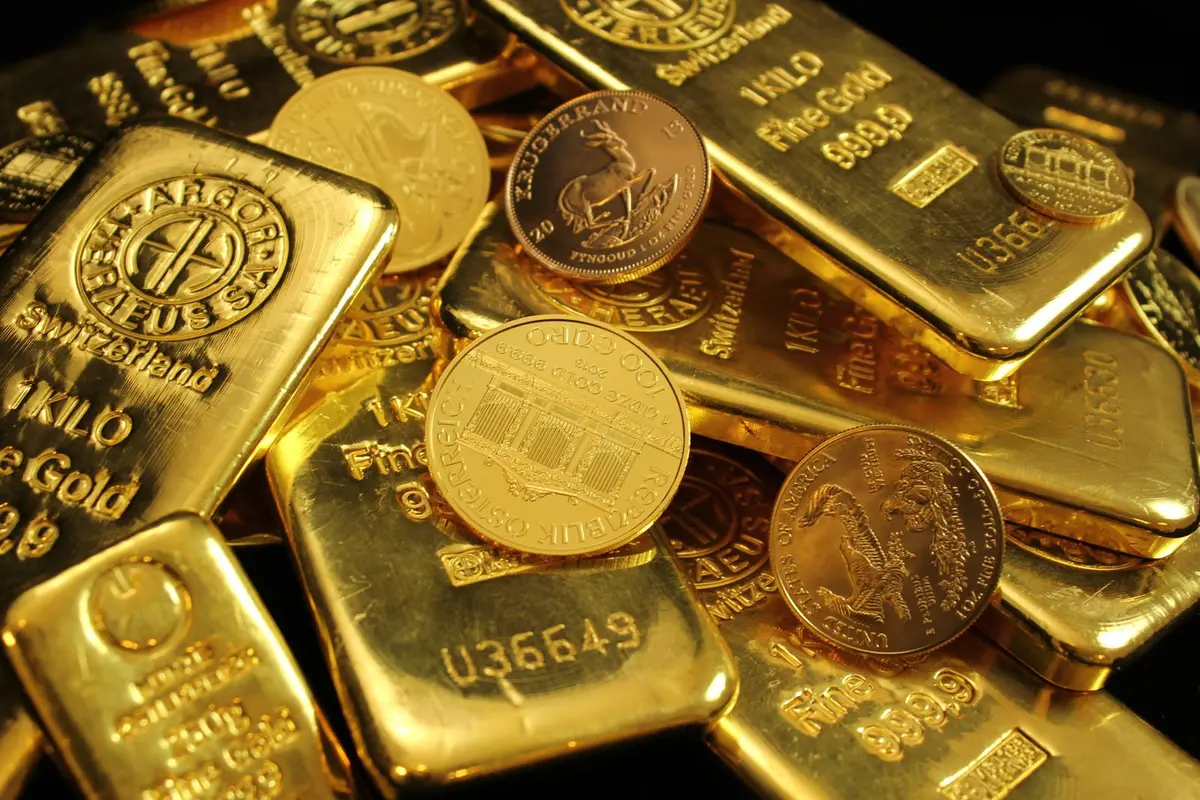
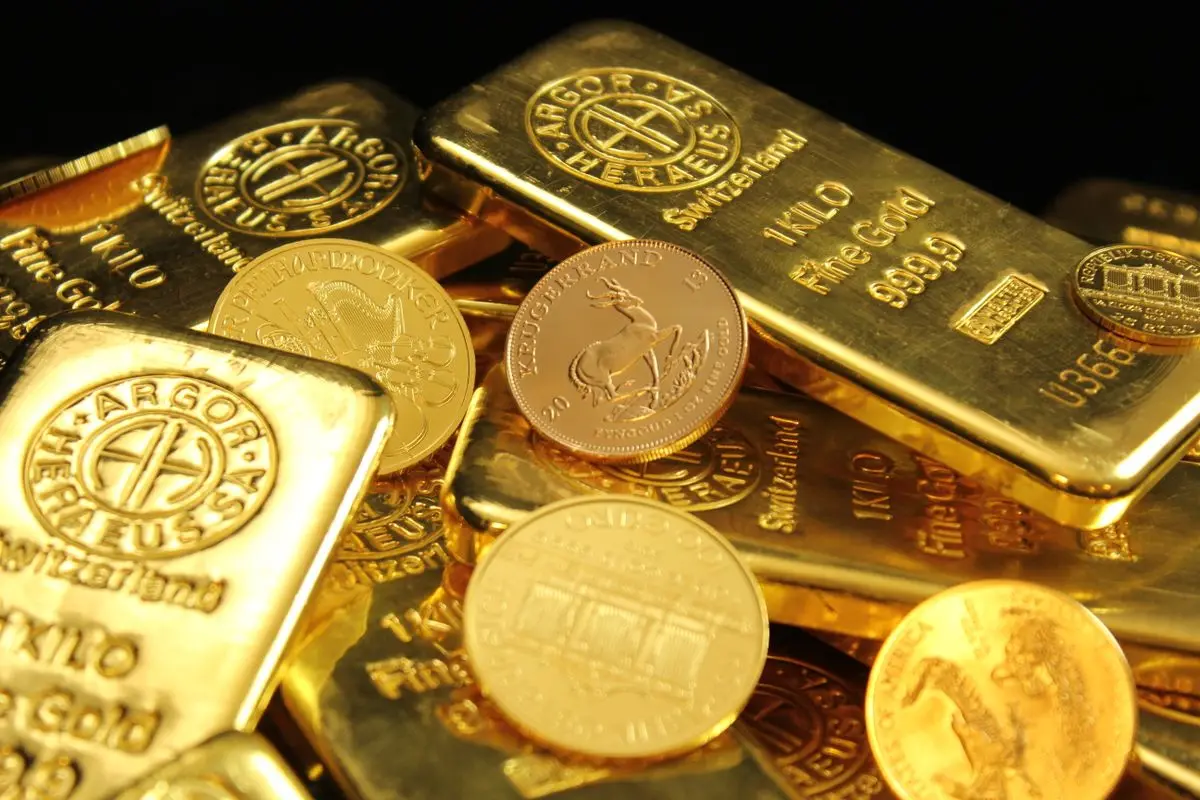
Gold’s advantage is not that its price never falls—it does. Its advantage is recognition. Canadian dealers, jewellers, refiners and many buyers abroad understand Maple Leaf coins and standard bars. Demand comes from jewellery, investment and central banks as well as private savers, and the market is deep enough that a standard product can usually be priced against a visible spot benchmark.
That liquidity is strongest when you keep the product simple. A standard 1 oz gold coin or bar normally has a clearer resale conversation than an unusual collectible whose buyer must value design, rarity and condition as well as metal. Small fractions can be useful, but their premium per ounce is often higher. Before buying, compare the premium and ask the dealer’s buy price for the same item today. Our Canadian premiums guide explains why that round trip matters more than the purchase price alone.
Silver: a lower ticket, not a cheaper shortcut
Silver attracts buyers because one ounce costs far less cash than one ounce of gold. That makes starting easier and can make gifts or staged purchases practical. But a low unit price is not the same as a low transaction cost. Small silver products can carry meaningful premiums as a percentage of spot, and a sum that fits in a few gold coins may require a heavy box of silver. Shipping, storage and counting all become real issues.
Silver also has a dual personality. It trades as a precious metal, but industry uses large quantities in electrical and electronic applications, brazing and soldering alloys, and other industrial processes. That industrial link can support demand, yet it can also make silver behave more like an economically sensitive commodity during downturns. Silver’s smaller market often produces larger percentage rises and falls than gold. That is an opportunity only if you knowingly want the volatility; it is not a discount version of gold.
Check the live Canadian price and product premiums on our silver price page, then ask how much physical space the purchase will occupy. A monster box may be sensible in a planned vault and miserable in a small apartment.
Platinum: scarce, industrial and less forgiving of product choice
Platinum is dense, corrosion-resistant and valuable in catalytic converters, chemical processing, electronics, glassmaking and jewellery. Its supply is geographically concentrated and annual production is far smaller than gold’s. Those features make it a genuine precious metal, but not a simple “gold, only rarer” trade. Rarity alone does not create a rising price: demand has to grow or remain strong while supply is constrained, and industrial users can change technology or substitute another metal when economics push them.
For a Canadian retail buyer, the practical issue is the exit. Fewer local shops stock and quote platinum than gold or silver. A recognizable Royal Canadian Mint platinum Maple Leaf or a standard refiner bar should be easier to discuss than an obscure product, but you still need the buyback quote before purchase. Ask whether the dealer buys platinum over the counter, at what discount to spot, and whether payment is immediate. If the answer is vague, the purchase is less liquid than the sales page suggests.
Gold vs silver vs platinum in Canada: the tax difference is form and purity
Canada’s GST/HST treatment is more precise than the common claim that “gold is tax-free and the others are not.” In CRA GST/HST Memorandum 17-1, a precious metal for GST/HST purposes is a bar, ingot, coin or wafer of gold, silver or platinum refined to at least 99.5% purity for gold and platinum, or 99.9% for silver. A supply meeting that definition is generally a supply of a financial service and generally exempt. The product also has to fit the form and trading-recognition rules; purity alone is not the whole test.
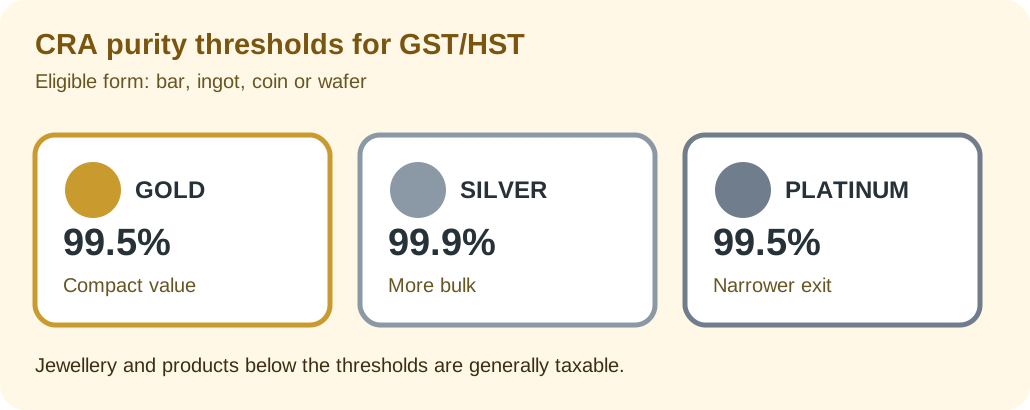
| Metal | Minimum purity in the CRA definition | Eligible forms named in the definition |
|---|---|---|
| Gold | 99.5% | Bar, ingot, coin or wafer |
| Silver | 99.9% | Bar, ingot, coin or wafer |
| Platinum | 99.5% | Bar, ingot, coin or wafer |
Jewellery, granular metal and products below the thresholds do not become exempt merely because they contain a precious metal; they are generally taxable supplies. Services such as refining or manufacturing can also have their own GST/HST treatment. Keep the invoice and product specification. In Quebec, ask how QST is being handled rather than assuming the federal answer settles every line of the bill.
GST/HST at purchase is separate from income tax when you sell. A gain can be taxable depending on whether the metal is capital property, personal-use or listed personal property, or business inventory, and losses have their own restrictions. Read our guide to capital gains on gold in Canada for the framework and keep purchase and sale records for every metal. This is general information, not tax advice.
Is gold a safe investment for financial security?
No physical metal is “safe” in the sense of a guaranteed value or a guaranteed buyer at yesterday’s price. Gold can fall, silver can fall harder, and platinum can spend years out of favour. Physical ownership removes some financial-system counterparty risks but adds theft, storage, insurance, counterfeit and liquidity risks. You also pay a premium when buying and usually accept a discount when selling, so the spot price may need to rise before you break even.
A better question is, “Which risks am I choosing?” Gold usually offers the broadest exit and compact storage. Silver offers a smaller starting ticket with more volatility and bulk. Platinum offers industrial scarcity with a narrower retail exit. None replaces cash reserved for emergencies, because a forced sale can happen on a bad price day. If a seller uses the word “safe” to stop you asking about premiums, buybacks or storage, that is a sales warning, not reassurance.
Is buying gold a good way to save money?
It can be a way to hold long-term savings in a tangible asset, but it is not a savings account. Buying in stages can reduce the pressure to pick one perfect day, an approach our Canadian timing guide explains without forecasts. The same discipline can be applied to silver or platinum, although the product and exit checks differ.
For saving, total cost matters more than the metal headline. Use standard products, compare total delivered cost, and avoid paying a collectible premium for an item you intend to value only by weight. If you are choosing between physical metal and a fund, our gold ETF vs physical gold guide compares custody, registered accounts and redemption. The best saving vehicle is the one whose costs and rules you understand before money leaves your account.
A Canadian decision checklist
- Purpose: Am I buying for long-term wealth storage, jewellery, a gift or industrial-metal exposure?
- Exit: Which Canadian dealer will buy this exact product, and at what spread today?
- Total cost: What are the premium, shipping, payment and possible storage costs as a percentage of spot?
- Tax form: Does the product meet the CRA purity and form definition, and does the invoice prove it?
- Storage: Can I store the actual volume securely, especially if I choose silver?
- Record: Do I have the invoice, purity, weight, serial number where applicable and purchase price for a future sale?
If two metals still look equal after those questions, choose the one with the clearer exit. In a real sale, liquidity is not a footnote—it is part of the return.
Frequently Asked Questions
Should I buy silver or gold or platinum?
Choose gold for compact value and the deepest resale market, silver for a lower cash amount per ounce if you accept volatility and bulk, and platinum for deliberate industrial-metal exposure after confirming a strong buyback. There is no universal winner.
Is gold a safe investment for financial security?
Gold is not guaranteed. It has a deep market and a long monetary history, but its price moves and physical ownership adds storage and counterfeit risks. Silver and platinum have the same warning, with silver often more volatile and platinum often less liquid at retail.
Is buying gold a good way to save money?
It can be a tangible long-term savings asset if you buy standard products at a competitive premium and can avoid a forced sale. It is not a substitute for emergency cash because the price and dealer spread may be unfavourable when you need money.
Do you pay GST or HST on silver and platinum in Canada?
Not automatically. Under the CRA definition, a bar, ingot, coin or wafer can be generally exempt when it is at least 99.9% silver or 99.5% platinum and meets the definition’s other requirements. Jewellery and lower-purity products are generally taxable. Check the invoice and product form.
Which metal has the lowest premium in Canada?
There is no fixed winner. Premiums vary by product size, maker, supply and dealer. Silver often has a lower cash price per ounce but can have a high percentage premium on small items. Compare premium and buyback together for the exact product.