Buying Gold on a Dip in Canada: Coins, Bars & Checks
Buying gold on a dip in Canada sounds simple: the price falls, you buy. This week it fell hard — spot gold dropped from above $4,000 to a Comex settlement of $3,878.40 in two days, and the Canadian 24K price slipped from about C$186.88 to C$183.72 per gram. But a dip is only a bargain if the premium you pay does not eat the discount. In a correction, premiums widen, popular products sell out, and the wrong product can cost more than the dip saved you. This guide covers what to buy, what to skip, dealer checks, and the tax and storage decisions to settle before you spend a dollar.
The first thing to understand is that the price you see online is not the price you pay. The spot price is the wholesale benchmark; the dealer adds a premium — minting, distribution, insurance and margin — and in a fast-moving correction that premium moves too. When demand surges, mints cannot increase production instantly, and premiums spike. A buyer who waits for a 10% dip and then buys the wrong product at a 12% premium has not bought the dip at all.
What to buy on a dip: coins and bars that keep the premium low
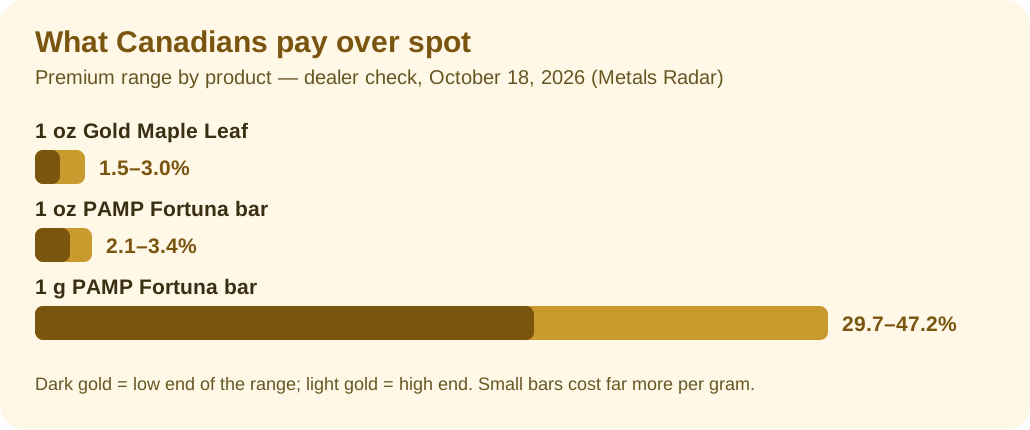
Buy the product with the lowest premium per gram that you can resell easily — in practice, full-ounce products from recognized mints and refiners. Real dealer data from Metals Radar's October 18, 2026 check of five Canadian dealers shows how wide the gaps are:
| Product | Premium over spot | Verdict on a dip |
|---|---|---|
| 1 oz Gold Maple Leaf | 1.5–3.0% | Best all-round buy |
| 1 oz PAMP Fortuna bar | 2.1–3.4% | Cheapest per gram |
| 1 g PAMP Fortuna bar | 29.7–47.2% | Avoid for investment |
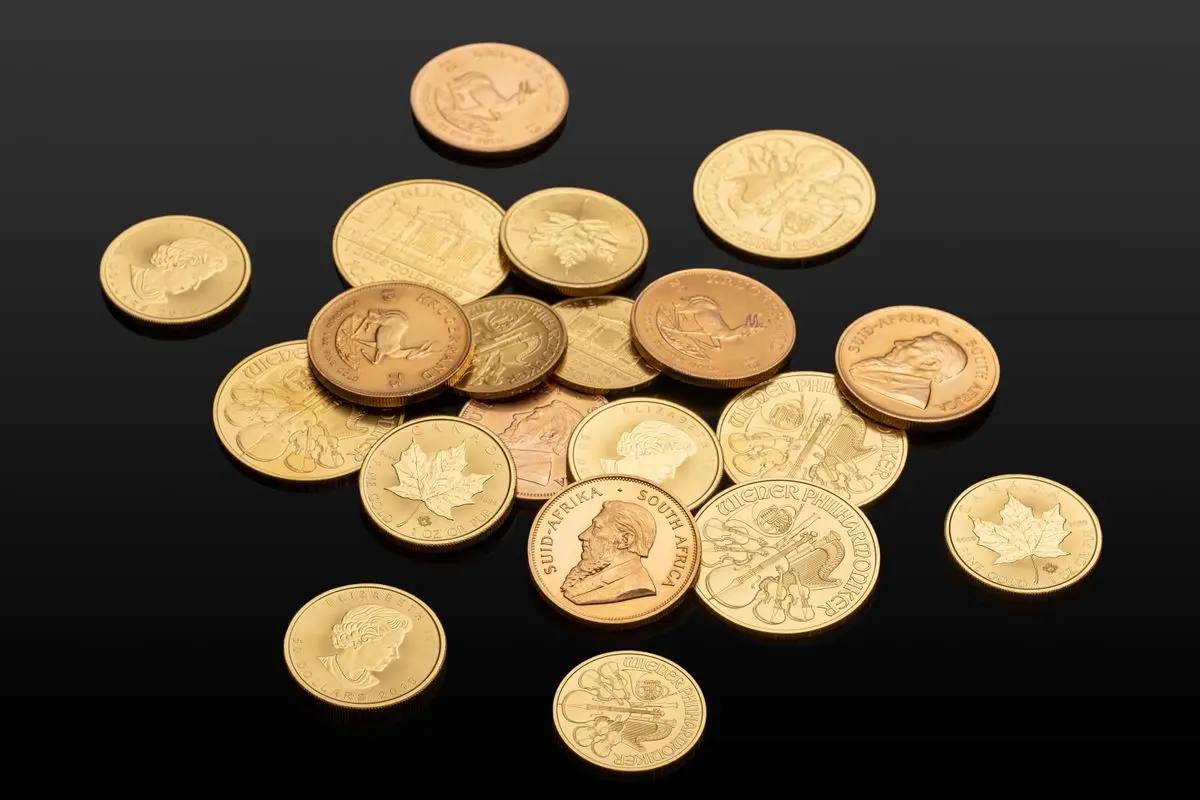
The 1 oz Gold Maple Leaf is the home-team coin: .9999 fine, made by the Royal Canadian Mint, recognized by essentially every dealer in Canada and most abroad, with three security features on 2026-dated coins — precision radial lines, a laser micro-engraved maple leaf, and the Mint's Bullion DNA technology. It typically carries the lowest coin premium in Canada. The 1 oz bar from an LBMA Good Delivery refiner such as PAMP Suisse, Valcambi or Argor-Heraeus is usually a touch cheaper still — typically 1.5–3% over spot — because there is no annual design or sovereign guarantee to underwrite. Either is a sound dip purchase. The full comparison is in our gold premiums guide.
What to skip on a dip

A correction is the wrong moment to buy products with structural markups — those markups compound on top of the dealer premium:
- Fractional coins (1/2 oz, 1/4 oz, 1/10 oz): 8–15% over spot, sometimes more. Striking a 1/10 oz coin costs nearly as much as striking a full ounce, so the per-ounce premium is much higher. They suit gifting and divisibility — not buying a dip.
- 1-gram bars: 29.7–47.2% over spot before shipping, according to Metals Radar — and two dealers in that data add C$25 or C$30 shipping to small orders, pushing the real premium on a single 1 g bar to 42.9% and 63.0%.
- Numismatic and "rare" coins: collectible premiums are subjective, hard to recover on resale, and a favourite of high-pressure sellers. Standard bullion is what you want.
Dealer checks before you pay
Premiums widen during demand spikes, so the dealer you choose matters more on a dip than in a calm market. Run these checks first — the full version is in our guide to gold dealers in Canada:
- Compare the premium, not the price. Dealer A sells a Maple Leaf at C$5,990 when spot is C$5,900 (1.5% premium); Dealer B sells at C$5,970 when spot is C$5,850 (2% premium). Dealer B's headline price is lower, but Dealer A's premium is lower — and premiums are what you control.
- Ask for the buyback price up front. "If I sell this back to you next year, what will you pay?" A trustworthy dealer answers immediately with a formula, such as spot minus 2%. The round-trip cost — buy premium plus sell discount, typically about 7% on a 1 oz coin — is your real cost of owning gold.
- Pay by wire or Interac e-Transfer. Credit cards add 2–3% in processing costs, passed straight to you. On a dip purchase, that surcharge alone can erase the discount you waited for.
- Verify the product. Sealed assay certification and a verifiable serial number — for Maple Leafs dated 2014 onward, the Bullion DNA micro-engraving. Our guide to telling real gold from fake covers the checks that work.
- Stick with established Canadian dealers. Kitco in Montreal, Silver Gold Bull in Calgary and Border Gold in Vancouver have decades-long track records, publish live prices and quote buyback prices. A dealer with no online footprint, no published prices and no buyback policy is one to avoid.
Taxes and the paperwork
Two tax facts shape every Canadian gold purchase. First, investment-grade bullion — bars, wafers and coins of at least 99.5% gold — is zero-rated for GST/HST, so no sales tax on a qualifying purchase. Jewellery and lower-purity coins are taxed. Second, selling at a profit is a capital gain: for an individual holding gold as an investment, half of the gain is added to income at the marginal rate. There is no separate gold tax rate and no minimum holding period. Keep every invoice — it establishes your adjusted cost base, and dealers do not issue capital gains tax slips. The worked example is in our capital gains tax guide. Nobody in Canada must report a gold purchase to the government; the reporting obligation arises only when you sell at a gain.
Storage: decide before you buy
Gold bought on a dip still needs somewhere safe to live. Decide before you order, not after the package arrives. A home safe bolted to the structure works for modest holdings, but check your home insurance — many policies cap jewellery and bullion coverage far below what buyers assume, and a rider may be needed. A bank safety deposit box is cheap and secure but has limited hours and no insurance from the bank. Allocated vault storage with a dealer or specialist costs a small annual fee and suits larger holdings. Our guide to storing gold safely at home covers the trade-offs in full.
Dip or dollar-cost averaging?
Nobody can reliably call the bottom — not even professionals. The November 12 intraday low of $3,852.58 looked like the bottom until the next headline arrived. The practical answer for most Canadians is to split the difference: use the dip to start or add to a position, then keep buying a fixed dollar amount at regular intervals regardless of price. That is dollar-cost averaging, and it buys more ounces when prices fall and fewer when they rise, without requiring you to predict anything. And if you are still unsure whether the timing is right at all, our guide on whether now is a good time to buy gold in Canada lays out the honest case both ways.
Frequently Asked Questions
Is it a good time to buy gold on the dip in Canada?
A 1.69% weekly drop to C$183.72 per gram is a better entry than a week ago — but only at a fair premium. A 1 oz Maple Leaf at 1.5–3% over spot is a genuine dip buy; the same dip bought as 1-gram bars at 30–47% over spot is no bargain. Check the premium first, then decide.
What is the best gold to buy during a dip?
A 1 oz Gold Maple Leaf or a 1 oz bar from an LBMA Good Delivery refiner such as PAMP Suisse or Valcambi. Both carry the lowest premiums per gram (about 1.5–3.4% over spot), resell easily anywhere, and — for the Maple Leaf — carry the Mint's Bullion DNA security features.
How much premium should I pay for gold in Canada?
In normal conditions, 1.5–3% over spot for a 1 oz bar and 3–5% for a 1 oz coin is fair; Metals Radar's October 2026 check found 1 oz Maple Leafs at 1.5–3.0%. Above 7% on a standard coin in a calm market, shop around — and expect wider premiums during a demand spike.
Do I pay tax on gold in Canada?
No GST/HST on investment-grade bullion of at least 99.5% purity. On selling at a profit, half of the capital gain is added to your income at your marginal rate. Keep your invoices — they establish your cost base, and no dealer will file the gain for you.
Where should I store gold bought in Canada?
Decide before you buy: a bolted home safe for modest holdings (check your insurance cap), a bank safety deposit box for mid-sized holdings, or allocated vault storage for larger amounts. Never store the invoice with the metal, and do not tell people you own gold.
Premium figures are from Metals Radar's October 18, 2026 check of five Canadian dealers and GoldSilver's mid-2026 dip-buying guide. Prices move intraday — check the live gold price in Canada and use our gold calculator before any purchase. This guide is general information, not financial advice.