Gold Maple Leaf vs Gold Bars: Which Should Canadians Buy?
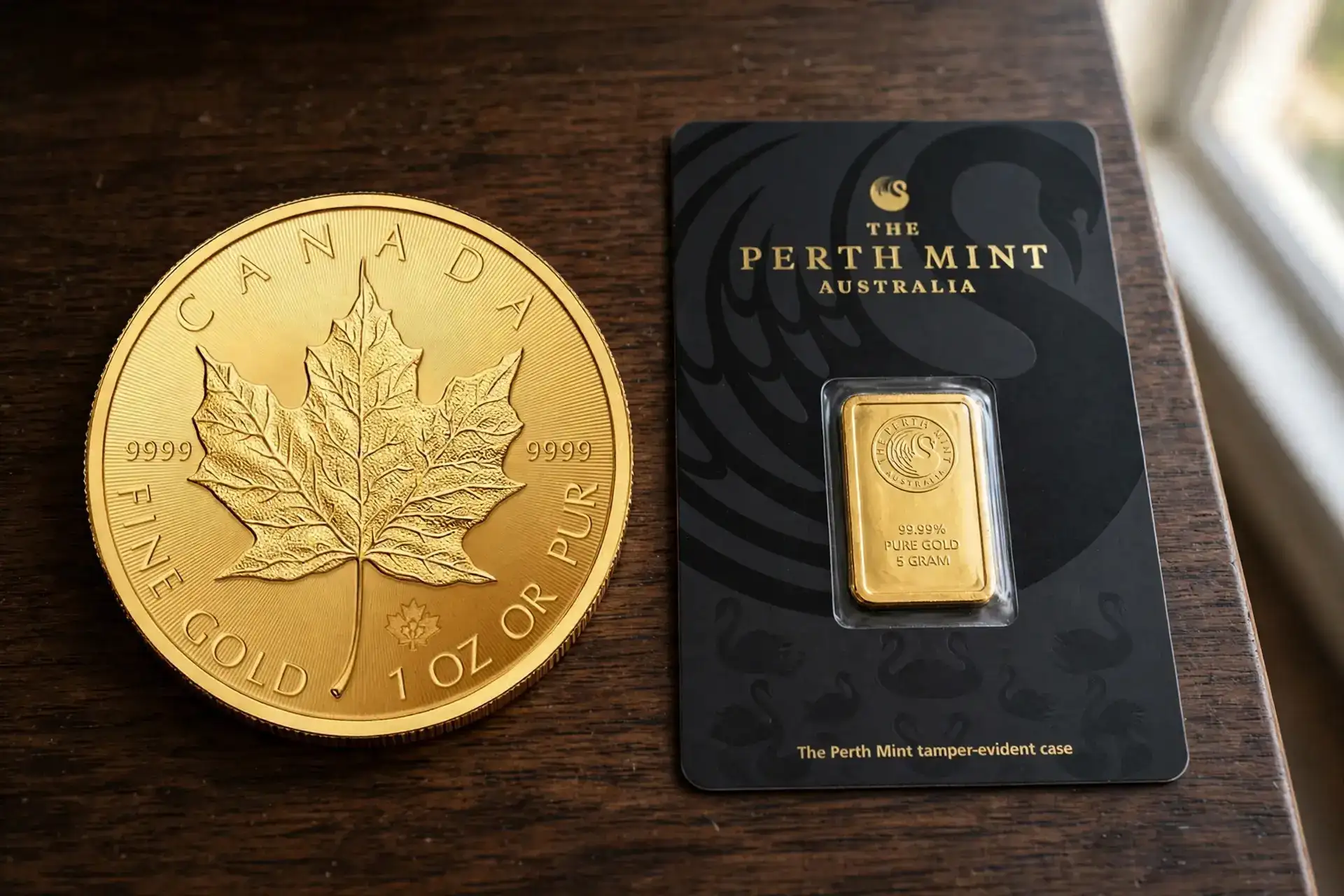
Almost every Canadian gold purchase comes down to the same fork in the road: a Gold Maple Leaf coin, struck by the Royal Canadian Mint, or a gold bar from a recognized refiner. Both can be .9999 fine. Both are GST/HST-exempt. Both track the same spot price. Yet they are not the same purchase — they differ in premium, security, flexibility and resale, and over a full round trip those differences are worth real money: on November 8, 2026, with spot at C$5,812.60 per ounce, the round trip on a 1 oz Maple Leaf cost about C$349–523, against C$233–349 for a 1 oz bar. This guide compares the two properly — costs, security, sizes, resale and tax — so you can pick the right ounce.
The short answer: bars win on cost per gram, Maple Leafs win on security and effortless resale in Canada, and most long-term holders end up owning some of each.
Gold Maple Leaf vs gold bars: the quick comparison
| Feature | 1 oz Gold Maple Leaf | 1 oz gold bar |
|---|---|---|
| Maker | Royal Canadian Mint (sovereign coin) | LBMA Good Delivery refiners (PAMP, Valcambi, RCM, Argor-Heraeus) |
| Purity | .9999 fine | .9999 fine (minted bars); .999+ (cast bars) |
| Typical premium (Nov 8, 2026) | 4–7% over spot | 2–4% over spot |
| Round-trip cost (buy + sell at 2% under spot) | C$349–523 | C$233–349 |
| Security | Radial lines, micro-engraved privy mark, Bullion DNA | Sealed assay card, serial number, refiner stamp |
| Legal tender | Yes — $50 face value | No |
| Sizes | 1 oz down to 1 gram (fractionals cost far more per gram) | 1 gram to 1 kg and beyond (bigger = cheaper per gram) |
| Resale in Canada | Instant recognition at every dealer | Easy for known refiners; generic bars may be tested |
The premium gap: what an ounce really costs
The premium is the amount over spot you pay to own the physical product, and it is where bars win. Using the November 8 spot price of C$5,812.60 per ounce (Kitco): a Maple Leaf at a 4–7% premium cost about C$6,045–6,219; a 1 oz bar at 2–4% cost about C$5,929–6,045. Selling back at a typical 2% under spot returns about C$5,696 either way. Subtract, and the round trip — the true cost of owning the ounce — is C$349–523 for the coin and C$233–349 for the bar, as the chart shows.
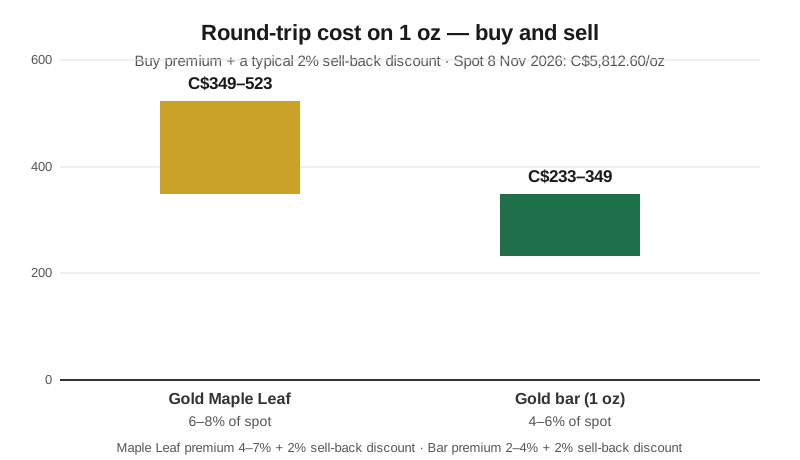
Why do coins cost more? A sovereign coin carries the design, striking and distribution costs of a national mint, plus anti-counterfeiting technology bars do not have. A bar is the refiner's most direct product. Neither premium is a rip-off — but the gap, roughly C$115–175 per ounce at November 8 prices, is the price of everything in the next section. Our gold premiums guide has the full range table for coins, bars and fractionals.
Security and authenticity: the Maple Leaf's home-field edge
The Maple Leaf is one of the hardest bullion coins in the world to fake convincingly. Current issues carry precision radial lines across both faces, a laser micro-engraved maple-leaf privy mark with the year visible under magnification, and the Royal Canadian Mint's Bullion DNA programme, which lets authorized dealers verify a coin's die signature against the Mint's database. It is also legal tender with a $50 face value — irrelevant at today's gold prices, but a sovereign guarantee no private product can match.
Bars answer with packaging: a minted bar from PAMP, Valcambi or the Royal Canadian Mint arrives sealed in an assay card with a matching serial number and certificate. Kept sealed, it verifies itself. The catch is that the seal is the security — a bar removed from its card, or a cast bar carrying only a stamp, may need testing at resale, and some dealers discount it. Our guide to telling real gold from fake covers the checks that work for both formats.
Sizes and flexibility: fractionals vs the big-bar discount
Coins divide; bars scale. Maple Leafs come in fractional sizes — 1/2, 1/4 and 1/10 oz, plus 1 gram — which makes them easy to gift or to sell in small pieces. The cost is steep: striking a tiny coin costs nearly as much as striking a full ounce, so fractional premiums run 8–15% or more per ounce, as our premiums guide sets out. Bars run the other way: the per-gram premium falls as the bar grows, and a 10 oz or 1 kg bar is the cheapest way to own gold per gram — but you cannot sell half a bar. If your exit plan involves selling in pieces, coins fit it; if it involves the lowest cost on a large holding, bars do.
Resale in Canada: who buys what, and how fast
In Canada, a Maple Leaf is the closest thing to cash the gold market has. Every dealer in the country quotes a buyback price for it on sight — typically around 2% under spot for a standard coin — because it can be resold the same day. Bars from LBMA Good Delivery refiners are nearly as liquid, especially sealed in their assay cards. Where bars lose ground is at the edges: generic or unbranded bars, and bars out of their packaging, can attract testing fees or wider discounts, and private buyers are warier of them. Either format resells best through the established dealers in our dealer guide — ask the buyback formula before you buy, not after.
Taxes and storage: the same rules for both
Tax does not separate them. Investment-grade gold — coins and bars of at least 99.5% purity — is zero-rated for GST/HST in Canada, and both the .9999-fine Maple Leaf and standard refiner bars qualify. On a sale at a profit, both are capital gains: half the gain is added to income at your marginal rate, as our capital gains tax guide explains. Storage differs slightly in practice: coins live happily in tubes or capsules and tolerate handling; minted bars are best left sealed in their assay cards, because a broken seal can cost you at resale. Our guide to storing gold safely at home covers the trade-offs.
So, Gold Maple Leaf or gold bars — which should Canadians buy?
The right choice depends on what you are optimizing for:
- Buy bars if: cost per gram is your priority, you are buying several ounces or more, and you are comfortable verifying a refiner's assay card. The saving compounds with size.
- Buy Maple Leafs if: it is your first purchase, you value instant resale anywhere in Canada, you want the strongest anti-counterfeiting protection available, or you may sell in small pieces.
- Do what many experienced holders do: hold the bulk of a position in low-premium bars and keep some Maple Leafs for flexibility.
And whatever you choose, buy it at a fair premium from an established dealer — our guide to buying gold on a dip in Canada shows the checks — because a bad premium costs more than the difference between them.
Frequently Asked Questions
Is a Gold Maple Leaf better than a gold bar?
Neither is better in the abstract. Bars are cheaper per gram (a 2–4% premium versus 4–7% for the Maple Leaf on November 8, 2026), while Maple Leafs carry stronger anti-counterfeiting features and resell instantly anywhere in Canada. The right choice depends on whether cost or liquidity matters more to you.
Why are gold bars cheaper than Gold Maple Leaf coins?
A coin carries a national mint's design, striking and security costs — radial lines, micro-engraving, Bullion DNA — plus a sovereign guarantee. A bar is a refiner's direct product, with fewer steps between the metal and you, so its premium is lower.
Do I pay GST or HST on Maple Leafs or gold bars in Canada?
No, provided the product is investment-grade — at least 99.5% pure. Both the .9999-fine Maple Leaf and standard .9999 refiner bars are zero-rated for GST/HST. Jewellery and lower-purity items are taxed.
Which is easier to sell in Canada: a Maple Leaf or a bar?
The Maple Leaf, by a small margin: every Canadian dealer recognizes it and quotes a buyback price on sight. Sealed bars from known refiners (PAMP, Valcambi, Royal Canadian Mint) sell almost as easily; unbranded or unsealed bars may be tested and discounted.
Are gold bars or coins better for a first purchase?
For most first-time buyers, a 1 oz Gold Maple Leaf: the premium is fair, the security features are the strongest available, and resale is effortless. If you are buying several ounces and cost per gram dominates, start with a 1 oz bar from an LBMA Good Delivery refiner instead.
Premium and round-trip figures are calculated from the November 8, 2026 spot price of C$5,812.60 per troy ounce (Kitco), using a typical 2% sell-back discount; premiums move with market conditions and dealer. Check the live gold price in Canada and our gold calculator before buying. General information, not financial advice.